
What are the taboo topics in ELT? How can we create an environment where students from diverse backgrounds can thrive? In this post, I’m going to talk about the PARSNIP approach, which offers a useful framework for navigating sensitive subjects, enabling ESL teachers and ELT materials writers to foster inclusivity while respecting students’ boundaries.
Understanding the PARSNIP
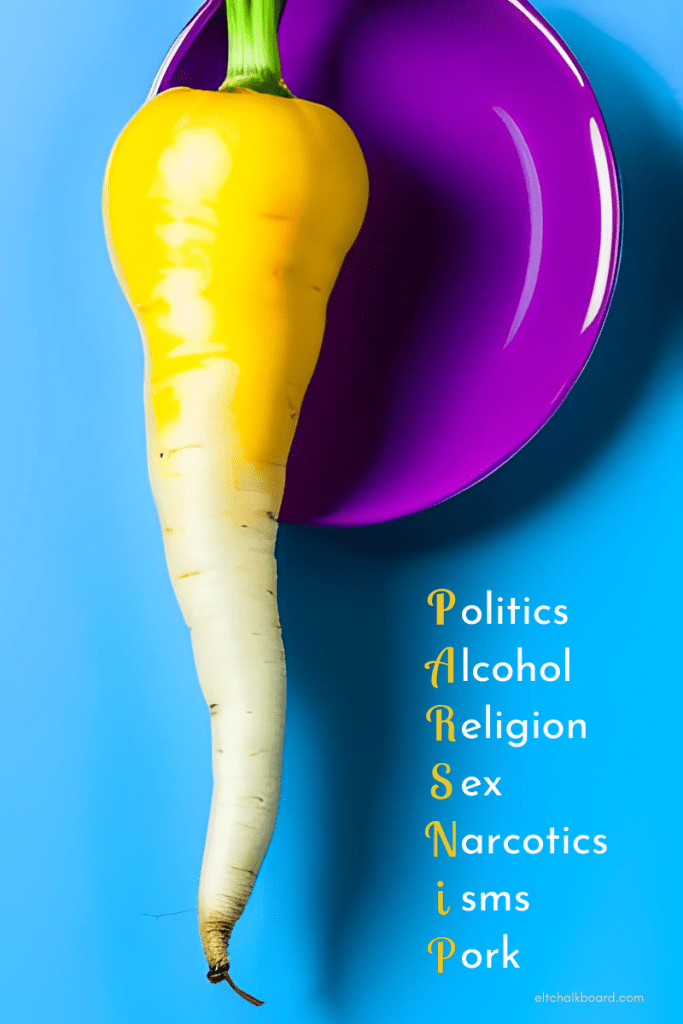
The word PARSNIP is an acronym that stands for Politics, Alcohol, Religion, Sex, Narcotics, -isms, and Pork. These are sensitive topics that are typically avoided in ELT materials to prevent potential offense or discomfort among learners. It is suggested that by steering clear of these subjects, we create an inclusive space that respects learners’ diverse cultural and social backgrounds. Let’s see how.
Politics
Politics is a highly divisive topic. When creating ELT materials, it is important to present balanced views, avoiding bias or favoritism towards any particular political ideology. Instead, we can focus on themes that promote critical thinking, global citizenship, and understanding different perspectives.
Alcohol
Alcohol consumption and attitudes towards it vary across cultures and religions. It is essential to be sensitive to these differences and avoid portraying alcohol as the norm or using it excessively in materials. Instead, we can explore topics related to healthy lifestyles, hobbies, or socializing in ways that are inclusive and respectful of diverse beliefs.
Religion
Religion is deeply personal and holds significant cultural value for many people. ELT materials should respect the diversity of religious beliefs and avoid promoting any specific religion. Instead, we may emphasize cultural celebrations, traditions, or values that are common across different faiths, fostering understanding and respect.
Sex
Sexuality is another sensitive and personal topic. ELT materials should steer clear of explicit or graphic content that may offend or make learners uncomfortable. We may focus on themes related to relationships, communication, or personal development that promote healthy discussions without crossing boundaries.
Narcotics
Drug use and abuse are also topics that should be handled with care. We must avoid glamorizing or normalizing drug use. Instead, exploring themes of health, well-being, and making informed choices to empower learners in making positive decisions will be better ideas.
-isms
The suffix “ism” indicates general principles, doctrines, and the names of specific schools of thought and theories. They are often avoided in ELT course books because they tend to have strong ideological associations and they have the potential to create controversy.
Pork
Pork is considered taboo in certain religious or cultural contexts. We need to be mindful of this when creating materials or writing lesson plans and ensure that alternative options related to the context or cultural references are provided.
Personal note:
I surely understand the importance of avoiding sensitive topics that might upset our students, but personally believe that as ESL teachers, we can find ways to include these subjects in our lessons. It’s a pity that we have to limit their discussion in class since they can provide valuable resources for interesting discussions and activities.
I think it is possible to find a delicate balance by introducing these topics gradually, while respecting our learners’ boundaries.
This is just my opinion, I think that by getting to know our students and their needs, we can make informed choices about what topics are off-limits in the classroom. Our main goal should be to create a comfortable and supportive environment where students feel relaxed and are engaged in learning the language.
Embracing Diversity and Inclusion

While the PARSNIP approach reminds us to be mindful of sensitive topics, embracing diversity and inclusion in ELT materials goes beyond avoiding controversial subjects. Here are a few additional considerations to create an inclusive learning experience:
Representation: Including diverse characters, stories, and examples from various cultures and backgrounds. This will help learners feel seen, represented, and valued.
Visuals: Using illustrations and images (with ALT texts if digital) that depict individuals from different ethnicities, genders, ages, and abilities. This visual representation will reinforce inclusivity.
Authentic Materials: Incorporating authentic materials, such as texts, audio recordings, and videos that represent diverse voices and perspectives. This will broaden learners’ understanding of different cultures and perspectives.
Ultimately, our goal as ESL teachers is to create a supportive and inclusive learning environment where our students feel at ease and actively participate in their language learning journey. Incorporating these considerations and gradually introducing relevant topics, we can foster engaging discussions while ensuring our students’ comfort.
Images by freepik
 ELT Chalkboard
Leave a comment