
We are all very familiar with writing lesson objectives and aims for different stages in our lesson plans as English language teachers. But it’s embarrassing for me to say, Bloom’s Taxonomy of educational objectives was something I came across only when I started studying for DELTA – which I haven’t completed. I didn’t pay much attention to the model until I found out that Bloom’s Taxonomy is also used to set more effective objectives for eLearning courses in instructional design. Although unfamiliar with the term, I’ve been intuitively applying it in my lesson planning. Most probably, you have, too!
What’s Bloom’s Taxonomy?
It’s a classification of different types of learning objectives which was originally developed in 1956 by Benjamin Bloom and his colleagues at the University of Chicago. It was then revised in 2001 in order to make it clearer for learners. Picture it as a pyramid, with the lower levels representing basic learning skills while the higher levels representing more complex learning skills. It has six levels.
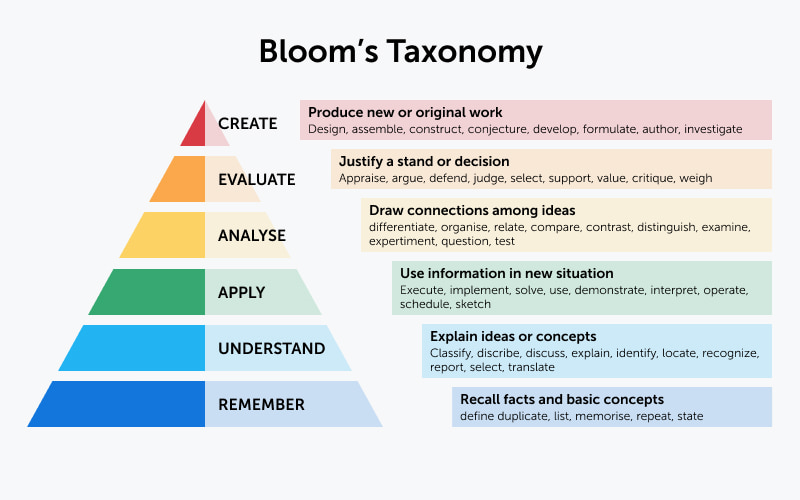
- Remembering: Recalling relevant information that has been learned previously.
- Understanding: Determining the meaning of information and being able to explain it in one’s own words.
- Applying: Using information to solve problems or complete tasks.
- Analyzing: Breaking down information into parts and understanding how they relate to each other.
- Evaluating: Making judgments about the value of information or ideas.
- Creating: Using the information to create something new, such as a piece of writing or a piece of art.
When planning a lesson, Bloom’s Taxonomy can be used to write more effective lesson objectives by helping us to focus on the different types of learning. In the classroom, it can be used to help us sequence our lessons in a logical order.
“Using the taxonomy to plan classroom procedures and activities allows us to raise the level of challenge smoothly so that learners are not being asked to do something for which they are unprepared.”
eltconcourse.com
I want to show you how it can be applied into classroom activities.
Bloom’s Taxonomy in Classroom Activities

1. Remember
After reading a short story about a group of friends who went on a camping trip, learners may be asked to:
- List the activities the friends did during their trip.
- Identify the order in which the activities took place.
- Describe the setting of the camping site.
- Recall the names of the characters in the story.
2. Understand
Working with the same story, learners may be asked to:
- Infer the relationships between the characters in the story.
- Explain why the friends decided to go on a camping trip.
- Identify the message conveyed in the story.
- Provide examples of camping-related vocabulary used in the story.
3. Apply
Working with the same story, learners may be instructed to:
- Write an email from a character in the story to their family about the camping trip.
- Role-play a conversation between two characters in the story discussing their camping experiences.
- Plan a camping trip with a friend including three of the activities they did in the story.
4. Analyze
Working with the same story, learners are instructed to:
- Compare and contrast the camping trip in the story with a real-life camping trip they have taken or heard of.
5. Evaluate
Learners are asked to do one of the following:
- Think of the last time they were on a trip to the countryside and list the things they did in order of how much they enjoyed it. Then record a video/audio message to send to a friend visiting the same area and suggest them what to do there.
- Debate the pros and cons of camping versus staying in a hotel, justifying their ideas.
6. Create
At this stage, the learners are ready to engage in freer practice and apply their knowledge and skills to create something new:
- Imagine that you are planning a rural trip to a foreign country. Research information about the camping sites and activities. Prepare a short presentation to share with classmates and try to persuade them to plan a visit to this place.
Each task is slightly more difficult than the previous one, ensuring the learners are in the Zone of Proximal Development, and resulting in more successful and confident production with better achievement of the learning outcomes.
Bloom’s Taxonomy Model in Instructional Design
Bloom’s Taxonomy is widely used in designing eLearning courses as well. Instructional designers use the taxonomy to write strong objectives in order to define clearly what the target audience will be able to do by the end of the course. And the whole course is designed accordingly.
This is achieved by using specific, measurable, and observable verbs in the objectives.
It’s important for the course designers to refrain from using passive verbs like “understand”, “learn” or “know” as these are not measurable.
Here are some good and bad examples of course objectives to see it better:
Not good: By the end of this course, employees will be able to understand the importance of safety in the workplace.
Good: By the end of this course, employees will be able to identify the three main causes of workplace accidents.
Not good: At the end of this course, you will know our company’s values.
Good: By the end of this course, you will be able to apply our company’s values to make ethical decisions.
Not good: By the end of this course, factory workers will have learnt about electrical safety.
Good: By the end of this course, factory workers will be able to recognize potential electrical hazards in the workplace and take appropriate measures to prevent accidents.
You can see that the good examples are more specific and measurable than the bad ones. Also, they have action verbs that are observable.
Just like in the lesson plans, eLearning course curriculum and activities should be designed to enhance learners’ abilities, starting from a lower skill level to the highest.
Since I’m on a journey to build up my skills to become an instructional designer, I’ll need to gain a deeper understanding of Bloom’s Taxonomy to apply it to my course design process so that I can write clear and concise learning objectives, and design activities to support them. A lot of way to go!

I hope you’ve found something valuable in this post.
Cheers to our continued learning! 💫
Images by freepik
👉🏼 Interested in seeing a learning theory in action? Check out how I used Gagné’s 9 Events to structure a complete digital writing lesson with EdTech.
2,667 hits


Leave a Reply